For decades environmentalists have been warning us that the demise of the human race may not be brought on by our technological weapons, but by a much simpler -- and scarier -- problem: the lack of water. Future wars, they predict, will not be fought for jingoistic reasons, but over water rights. The concept that there isn't enough water to go around is difficult for those of us in the developed world to wrap our brains around because we rarely, if ever, face a time when water doesn't flow out of our faucets and hoses. In the American Southwest -- as well as in Texas, which experienced the worst drought in decades last year -- we water our manicured lawns year-round, creating artificial oases to satisfy our aesthetic needs without considering for an instant the damage we are inflicting on this precious resource.
In the rest of the world -- even in the most advanced "developing" nations -- lack of infrastructure compounded by diminishing resources has complicated billions of ordinary lives. As a child in New Delhi, I remember the gallons of water we kept around our house that would be refilled in the 30 minutes when water would flow freely through the faucets during the height of the summer drought. A particular image -- that of the Jamuna river dried up in its bed -- is strangely imprinted in my memory, and it is that memory I returned to this week after several days of experiencing water-related mishaps.
On Tuesday morning, in the middle of my shower, just as I had put shampoo in my hair, I heard the shower faucet sputter and then quietly turn off. After my initial panic abated -- luckily, I had some water left in my kettle to make a cup of tea to calm myself down -- I went downstairs to inquire if this was a building-wide problem. (I did dry myself off and put on clothes before doing that...). Naturally, I got an unsatisfactorily vague answer from the dezhurnaya on duty, who called the repair man and assured me it would be "fixed soon." Several hours later, with shampoo dried into my hair and still no sign of water flowing from the faucets, I decided to take matters into my own hands. Years of living and visiting India have taught me two extremely valuable lifeskills that I have occasionally had to revive: how to bathe with no running water, and how to properly use a squat-toilet. With the remaining water in the kettle, I managed to wash the shampoo out of my hair and take something just a shade better than a sponge bath.
At work, I found out the university was experiencing its share of water problems, though these were blamed on the massive amounts of ongoing construction on campus. Nevertheless, it appeared the lack of water was a citywide issue, not just another cruel joke on me personally. Over the next few days -- really, until last night -- the water continued an unpredictable course of shutting off and on with little warning. Some days there was hot water, some days only cold, and some days, nothing. After my Tuesday experience, though, I was prepared, and took mostly what I like refer to as "Third World" showers (or, you know, Global South showers, if you want to use slightly less offensive language), using my kettle to boil the water and my laundry bucket to mix it with cold water.
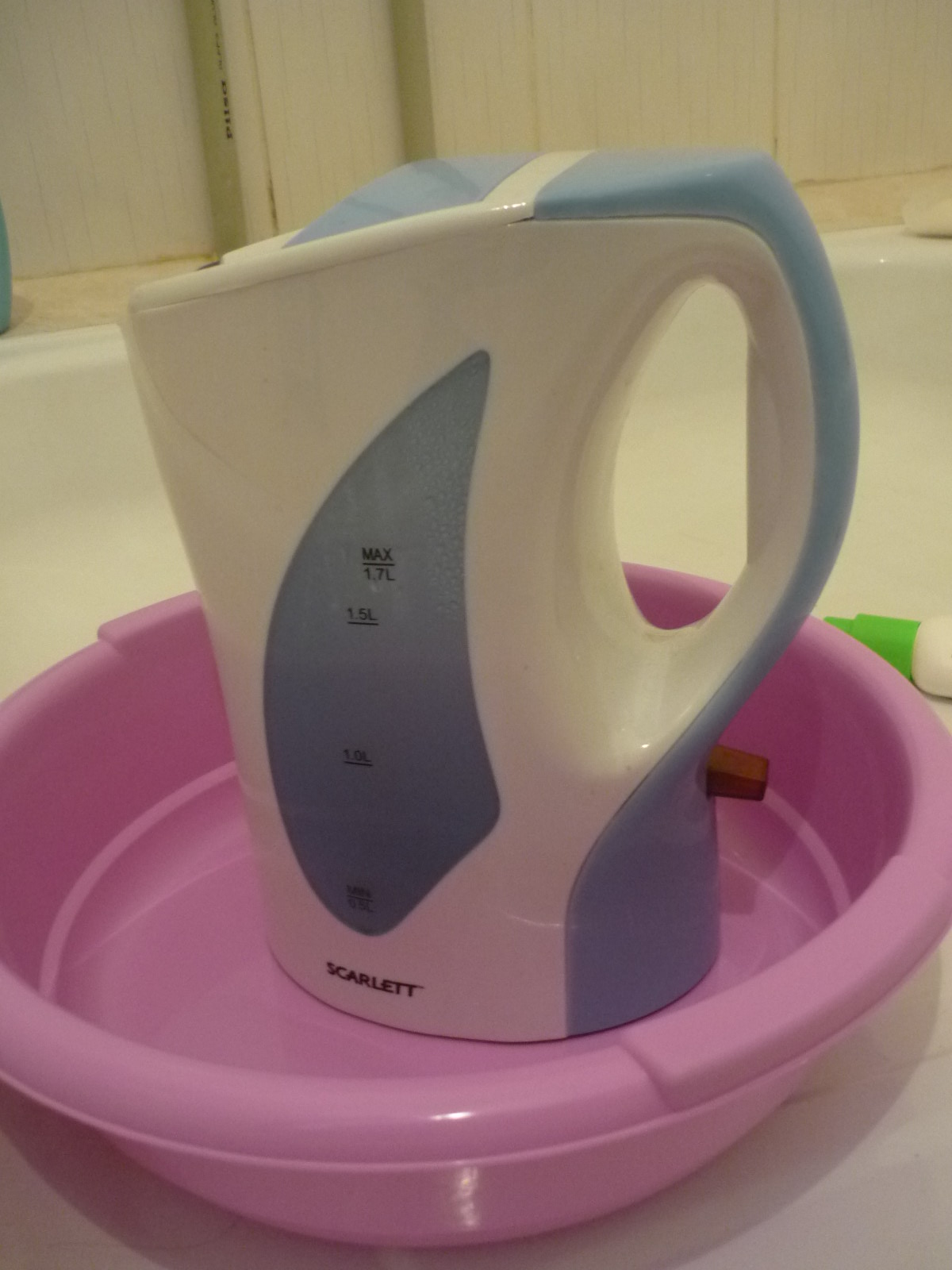 |
| No hot water? No problem. All you need is a kettle and some sort of tub! |
Of course, this got me thinking. The average 8-minute shower uses about 62 liters of water, according to this BBC News story. I managed relatively the same on 8 to 10 liters. True, I probably would have liked to use a little bit more water, but even if I added 5 to 7 more liters, that still brings my total to about 1/4th of the water consumption in an average shower. So, why is it, exactly, that we haven't adopted a less-wasteful shower regimen?
Though I suspect the water problems this week were related to infrastructure development, the larger issue of water resources looms large in Central Asia. All five post-Soviet republics rely on the rivers that flow through their shared borders for water, agriculture and electricity, and while Uzbek President Islam Karimov's recent ominous prediction of a water-related war was hyperbolic, it is not all that far-fetched. The region's two major rivers -- the Syr Darya (Jaxartes) and Amu Darya (Oxus) -- meander across the borders of all five countries and Afghanistan. Future plans to dam rivers upstream in Tajikistan and Kyrgyzstan, where the population relies on hydroelectric power, will undoubtedly affect Uzbekistan and Kazakhstan downstream. Water resources often play a role in political leverage. In 2010, when Kazakhstan closed its borders with Kyrgyzstan after a popular uprising, the Kyrgyz government shut off the water flow from the Talas river into eastern Kazakhstan. The flow was restored days after the border reopened. The role of water resources in Central Asia is not a modern -- or post-Soviet -- problem. (In fact, my cousin wrote her dissertation on the contestation of water rights in Central Asia under Russian rule -- I'm hoping that's an accurate description of her work!). Likewise, the desiccation of the Aral Sea, which continues to shrink each year, is largely related to diversion of water resources in the Soviet era.
 |
Photo of the Aral Sea in Uzbekistan (from user: kvitlauk on Flickr).
|
Diminishing water resources -- or potential fights over those resources -- are not limited to Central Asia. The southern Indian states of Tamil Nadu and Karnataka, the region where my family is from, are engaged in a decades-long standoff over the rights to control the Kaveri (Cauvery) river that straddles the border and is the lifeblood of major cities in both states. The population growth on both sides of the Rio Grande river has complicated efforts by states to hold up their end of the compact that ensures water flows downstream into the Gulf of Mexico. In short, we are seeing glimpses of the future in which fights over water -- and the lack of water -- will be commonplace all over the globe.
So, even though there's water flowing quite freely out of my faucet today, I hope this experience, while frustrating and inconvenient, will remind me that I, too, am far too complacent about my own water use. I'm not quite ready to give up showers -- those of you who know me well know my love of showers -- but I think I can start by taking shorter, more effective ones.
Next time on this blog: When every conversation turns into a discussion about nationalism.
